I tested the 'avoid August' rule against 67 destinations
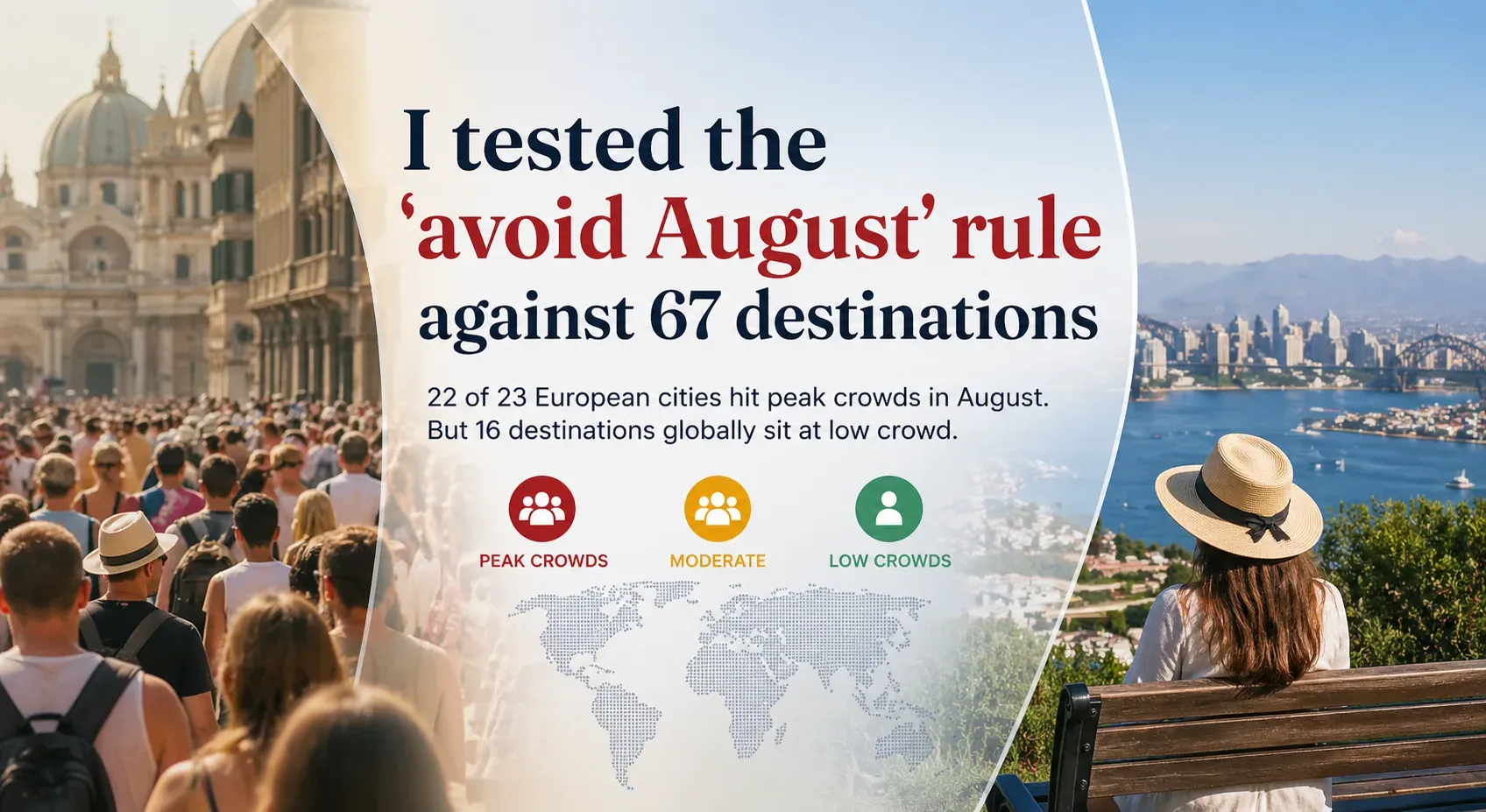
22 of 23 European cities hit peak crowd in August. But 16 destinations globally sit at low crowd. The dataset, the chart, and the cities that break the rule.
We went to Hawaii in September. Not early September, not “end of summer” September. Properly into the month. Locals at a trailhead on Oahu mentioned how packed it had been the week before, how the parking lots had overflowed all through August, how we had just missed the chaos. We hiked Diamond Head with maybe fifteen other people. The North Shore beaches were empty enough to sit wherever we wanted. One week earlier, apparently, you could not find a parking spot.
That timing stuck with me. The difference between August and September at the same destination was the difference between fighting for space and having it to yourself. And it got me wondering: is August actually the universal worst-case for every destination, or is that mostly a European and North American story?
So I tested it. 67 destinations. One question per city: what is the crowd level in August?
22 of 23 European cities hit peak crowd. But 16 destinations globally, nearly a quarter of the dataset, sit at low crowd in August.
How I tested this
I maintain structured JSON files for 67 destinations at travelvient.com. Each file includes a seasons array with crowdLevel classifications (peak, high, moderate, low) broken out by month range, plus a bestTimeToVisit.avoidPeriod field where the data explicitly warns against certain months.
For each destination, I found the season entry whose month range includes August and read its crowdLevel value. I also checked whether August appeared in the avoidPeriod string.
The data was last updated between April 23 and April 29, 2026. Four destinations (Bali, Cartagena, Dubai, Lima) lacked August crowd data and are excluded from the crowd-level counts but included in the chart with “n/a” markers.
The full dataset is downloadable as a CSV: 67-destinations-august-crowd-test-2026.csv.
Two things this test does NOT do. It does not measure crowd levels with sensors or ticket-gate counts. These are editorial classifications based on tourism board data, occupancy patterns, and published travel guides. Different sources would draw the lines differently. And it classifies at the city level, not the country level. A city being “peak” does not mean the entire country is packed. Rural Provence in August is a different experience from Paris.
The chart
Bar width shows the August high temperature in Fahrenheit (scaled to 109°F, Cairo’s high). Color shows crowd level: red = peak/high, amber = moderate, green = low.
Europe (23)
Every single bar is red. Madrid is the closest thing to an exception, classified as “high” rather than “peak” because the 97°F heat drives tourists toward coastal Spain. But high is not moderate. Europe in August is wall-to-wall.
North America (24)
North America is more interesting. The US cities you associate with summer, from New York to Seattle to Hawaii, are all peak or high. But scroll down to the green bars. Cancun is low-crowd in August (hurricane season scares people off). Mexico City at 77°F and low crowd is one of the best-value entries in the entire dataset. Miami and New Orleans are low-crowd because the heat and humidity are brutal, and the locals know it.
Asia (11)
Zero peak-crowd cities. Only Osaka hits peak. The Japanese cities (Kyoto, Tokyo) are moderate because the Obon holiday in mid-August brings domestic travel, but international tourist volume is lower than spring cherry blossom season. Southeast Asia is almost entirely low-crowd in August: it is monsoon season across Thailand, Vietnam, and Taiwan, which drops prices and thins crowds even though the rain is usually a short afternoon burst rather than an all-day washout.
Seoul at 86°F and low crowd is a standout. The city has excellent transit, the food scene does not slow down in summer, and August sits between the spring and autumn tourist waves.
Africa (3)
All three African cities are low-crowd. All three green. But look at the bar widths. Cairo hits 109°F and Marrakech 108°F. These are not hidden gems. They are empty because the heat is dangerous. Cape Town is a different story: it is winter in the Southern Hemisphere, 63°F, and genuinely pleasant for hiking and wine country if you pack layers.
South America (4)
Buenos Aires in August is winter. Highs around 64°F, low crowds, and steak dinner prices that look like a rounding error compared to Paris. The city does not shut down in winter; the theater and restaurant scene stays active.
Oceania (1) & Middle East (1)
Sydney in August is mid-winter, 63°F, low crowd. The Opera House, the harbor walks, and the Blue Mountains are all open. You will want a coat.
The findings, ranked
The rule is right in Europe. 22 of 23 cities hit peak. 14 of those 23 explicitly list August in their avoid period. This is not a nuanced finding. If you are going to Europe in August, you are going at the most crowded, most expensive time.
The rule breaks down outside Europe and the US. Asia has zero peak-crowd cities in August. Africa has zero. South America has zero (Medellin is “high” but not peak). The “avoid August” advice is really “avoid August in the Northern Hemisphere’s wealthy tourist corridors.”
The Southern Hemisphere flips the script. Cape Town, Sydney, and Buenos Aires are all in winter during August. Low crowds, lower prices, and weather that ranges from brisk to mild. This is the most reliable August contrarian play in the dataset.
Some low-crowd cities are low for a reason. Cairo at 109°F and Marrakech at 108°F are not invitations. They are warnings. Miami at 92°F with peak humidity is technically low-crowd, but if you have spent an August afternoon in South Florida, you understand the tradeoff. “Low crowd” and “good time to visit” are not the same thing.
The genuine surprises are Seoul, Mexico City, and Bangkok. Seoul (86°F, low crowd) has comfortable weather and does not thin out its food and nightlife scene in summer. Mexico City (77°F, low crowd) is 7,350 feet above sea level, which keeps August temperatures mild, and the rainy season means brief afternoon showers rather than gray all-day rain. Bangkok (93°F, low crowd) is hot, yes, but it is always hot, and the monsoon-season hotel rates can run 40-50% below peak.
If you want to check seasonal details for any of these cities, I keep updated destination guides at travelvient.com.
What this data does not tell you
These crowd levels are editorial classifications. I built them from tourism board data, published travel guides, and hotel occupancy patterns. They are not measured with turnstile counts or cell-phone density data. A different source might draw the peak/moderate/low boundary in a different place, and I would not argue with them.
The city-level view also hides a lot of variance. Paris being “peak” does not mean every arrondissement is equally packed. The Marais and the Eiffel Tower area are shoulder-to-shoulder in August, but the 13th arrondissement is not. Edinburgh during the Fringe Festival in August is a different city than Edinburgh the week before the Fringe starts.
And “low crowd” sometimes just means “bad weather.” I flagged this in the Africa section, but it applies elsewhere too. Cancun is low-crowd in August because it is hurricane season. The statistical likelihood of a direct hit during your specific week is small, but the risk changes your refund calculus, and some hotels close their beach services during storm watches.
The real problem is pricing
Here is the take I would defend at a bar. The crowds are manageable. You can book timed-entry tickets for the Uffizi. You can reserve a restaurant in Barcelona a week ahead. You can wake up early and beat the lines at Dubrovnik’s walls. Crowds are an inconvenience, not a dealbreaker.
The pricing is the dealbreaker. A round-trip flight to Rome in August can run $1,200 from the East Coast. The same flight in October: $550. A hotel in Santorini that costs $180/night in May costs $400+ in August. For a family of four on a ten-day trip, the August premium can add up to $3,000-$5,000 in flights and hotels alone. That is not an inconvenience. That is a second vacation’s worth of money.
The 16 low-crowd destinations in this dataset are interesting not because they are secret or obscure, but because they are priced for off-season while the rest of the world’s travelers pile into Europe and pay the premium.
What I want to test next
I have seasonal data for all 67 destinations, not just August. I want to run the same test for every month and find the month where the most destinations globally hit low crowd. My guess is February or November, but the data might surprise me. I also want to cross-reference crowd level against the daily budget cost data I maintain for these same cities, which would answer a more practical question: where is the cheapest low-crowd destination for each month of the year?
The dataset CSV is here: 67-destinations-august-crowd-test-2026.csv. If anything looks wrong or you have crowd data from a city I missed, I would like to hear about it.
Frequently Asked Questions
Is August really the worst month to travel to Europe?
Which destinations are actually low-crowd in August?
Why are some cities low-crowd in August if the weather is fine?
How reliable is this crowd-level data?
Is the 'avoid August' rule about crowds or about pricing?
Travel data researcher and publisher
Caden Sorenson runs Travel Vient, an independent travel research site built on a verified database of airline baggage rules, airport connection times, cruise line policies, and eSIM plans. He built the verification pipeline behind it: every figure is read from the airline, airport, cruise line, or government page that publishes it, stored with that source link and the sentence it came from, and re-checked on a schedule. He is a senior staff engineer with 15+ years building software, a Computer Science graduate of Utah State University, and based in Logan, Utah.
Figures on this page were read from the official source they link to and show the date they were last checked.
Related posts
- 75 Destinations Ranked by Daily Budget: 2026 DataMaui costs 8.5x Ho Chi Minh City per day. Every US city in the dataset sits in the top third. The full ranking, the chart, and why the daily number lies.
- Reliability vs Fees 2026: The $90 Bag-Fee Airlines Are the Least On-TimeWe crossed verified bag fees for 80 airlines with Cirium on-time and US DOT cancellation data. The carriers charging $90 a round trip sit at the bottom.
- The 2026 Baggage Fee Index: $0 to $140 for the Same TripAcross 47 airlines that publish a flat first-bag-trip fee, the round-trip spread runs $0 to $140. 29 include a carry-on plus a checked bag free. The US legacy carriers all sit at exactly $90.
Related guides
- GuideWhat to Wear on a Cruise in 2026: Formal Nights, Dinners, and Dress CodesWhat to wear on a cruise in 2026: casual by day, smart casual at dinner, and one or two formal nights. Line-by-line dress codes, plus what men and women pack.
- GuideAir France vs Lufthansa Business Class 2026: Which Wins?Air France's new '3 Fs' Business seat and Lufthansa's Allegris are Europe's two headline business cabins in 2026. Which wins on the seat, the door, the screen, and which aircraft you actually get?
- GuideCathay Pacific vs Singapore Airlines Business Class 2026: Which Wins?Cathay's Aria Suite and Singapore's fully-flat business are Asia's two most decorated business cabins in 2026. Which wins on seat, doors, screens, and which aircraft you actually get?
Related comparisons
- Airline ComparisonANA vs Singapore Airlines 2026: Which Should You Fly?ANA's The Room business class and dual Tokyo hubs vs Singapore Suites and free fleet-wide Wi-Fi. Two Star Alliance giants compared on cabins, bags, and loyalty.
- Airline ComparisonANA vs United 2026: Which Wins the Transpacific Run?ANA THE Room and Japanese economy vs United Polaris, Starlink Wi-Fi, and US feed. Business class, on-time, routes, and MileagePlus vs ANA Mileage Club compared.
- Airline ComparisonCathay Pacific vs Emirates 2026: Which Should You Fly?Cathay's new Aria Suite with full sliding doors vs Emirates' A380 onboard shower, bar, and ICE. Business class, economy, hubs, loyalty, and bags compared.